
Iran Market Opportunity: A Strategic View of Demand, Infrastructure and Investment1
Iran is often discussed through the lens of sanctions, geopolitical risk, currency volatility and regulatory complexity.
Those factors are real.
But they are only one side of the equation.
The other side is a large domestic market, exceptional geographic positioning, substantial energy resources, a broad industrial base, significant mineral production, and a persistent need for modernization across infrastructure and productive capacity.
For international companies and investors, the more important question may therefore not be whether Iran has economic potential.
It is:
How can that potential be accessed responsibly, legally and strategically?
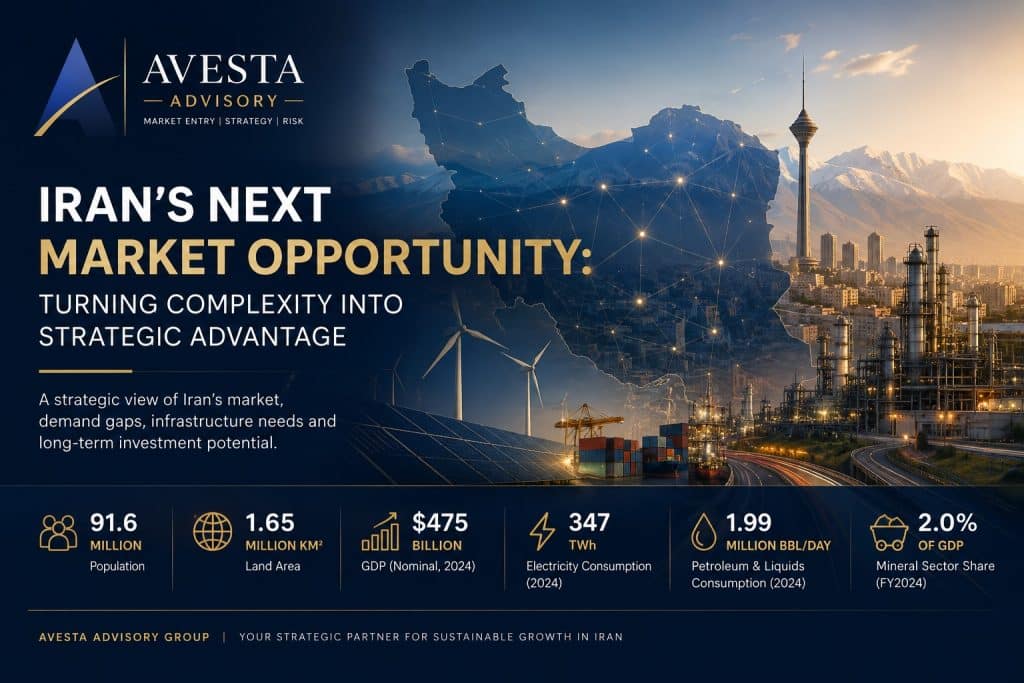
Iran by the Numbers
For executives evaluating a new market, a few numbers can reveal more than dozens of general descriptions.
| Key Indicator | Iran |
|---|---|
| Total Area | 1,648,195 km² |
| Population | 91.6 million |
| 2024 GDP, current US$ | $475.3 billion |
| 2024 Electricity Consumption | 347 TWh |
| 2024 Petroleum & Liquids Consumption | 1.999 million barrels/day |
| 2022 Electricity Generation | 360.7 TWh |
| Coastline | 2,440 km |
| Mineral sector share of GDP, FY2024 | 2.0% |
Iran’s total territory is 1,648,195 km², while its population reached about 91.6 million in 2024 according to the World Bank. (Tehran Embassy)
The World Bank reports nominal GDP of approximately $475.3 billion in 2024. (DataBank)
Energy consumption is particularly significant. The U.S. Energy Information Administration estimates Iran’s 2024 electricity consumption at 347 billion kWh, while petroleum and other liquids consumption reached approximately 1.999 million barrels per day. (U.S. Energy Information Administration)
These figures matter because they describe something deeper than the size of the economy:
They describe the scale of the systems that need to operate, expand, modernize and become more efficient.
A Large Market Does Not Always Mean a Mature Market
This is where Iran becomes particularly interesting.
A market can be large without being fully developed.
And a market with significant consumption can simultaneously experience shortages, inefficiencies and infrastructure constraints.
That apparent contradiction is precisely where investment opportunities can emerge.
Consider electricity.
Iran generated approximately 360.7 TWh of electricity in 2022, with natural gas accounting for about 85% of generation.
By 2024, electricity consumption had reached approximately 347 TWh. (U.S. Energy Information Administration)
The implication is not simply that Iran consumes a great deal of electricity.
It is that energy efficiency, generation capacity, transmission, distribution, cooling systems, industrial energy management, distributed generation and renewable power can all become economically relevant areas of development.
This is a recurring pattern across the Iranian economy.
The Hidden Market: Demand That Does Not Appear on a Balance Sheet
Some of the most interesting opportunities are not created by new consumption.
They are created by inefficient existing consumption.
Fuel provides a good example.
Iran’s petroleum consumption is already substantial, while the country has simultaneously been trying to control gasoline demand and reduce the fiscal burden of fuel subsidies. In December 2025, Reuters reported that gasoline demand was exceeding domestic production capacity of approximately 110 million litres per day, prompting a new pricing tier for higher consumption. (Reuters)
This creates a much broader investment question:
What happens when a large economy consumes enormous quantities of subsidized energy through relatively inefficient systems?
The answer is not necessarily simply “produce more fuel.”
It can mean opportunities in:
- Energy efficiency
- Vehicle modernization
- Public transportation
- Industrial efficiency
- Smart energy management
- Renewable generation
- Building energy management
- HVAC modernization
- Power-grid optimization
- Fuel logistics and infrastructure
In other words:
A consumption problem can become an efficiency market.
Natural Gas: Abundance Meets Domestic Demand
Iran possesses one of the world’s largest natural-gas resource bases.
The EIA ranks Iran as the world’s second-largest holder of natural-gas reserves as of the end of 2023. It also identifies Iran as the world’s third-largest dry natural-gas producer in 2022. (U.S. Energy Information Administration)
Yet abundant resources do not automatically translate into abundant investment opportunities.
Production infrastructure, processing, transmission, efficiency, equipment modernization and domestic demand all matter.
This distinction is crucial for investors:
Resource abundance does not eliminate infrastructure requirements.
In many cases, it increases them.
Oil Is Not the Whole Story
Iran’s energy profile is often reduced to crude oil.
That is strategically incomplete.
The country’s economic opportunity extends across:
Energy → Petrochemicals → Manufacturing → Mining → Infrastructure → Logistics → Technology → Healthcare → Consumer Markets
The mineral sector alone illustrates the scale of the underlying industrial base.
According to the U.S. Geological Survey, in 2024 Iran ranked:
- 1st globally in strontium production
- 2nd in direct-reduced iron
- 2nd in mined gypsum
- 3rd in feldspar
- 5th in iron ore
- 6th in cement
- among the world’s significant producers of several other industrial minerals and metals. (USGS)
At the same time, USGS estimates that the non-hydrocarbon mineral sector accounted for approximately 2.0% of Iranian GDP in fiscal year 2024. (USGS)
This combination is significant.
Iran already has an industrial and mineral production ecosystem.
The opportunity is therefore not necessarily about creating an industrial economy from zero.
It is often about:
modernizing → upgrading → expanding → integrating → improving efficiency → adding value.
Geography Is an Economic Asset
Iran’s geography is another underappreciated component of its long-term economic potential.
With approximately 1.65 million square kilometres of territory, Iran is one of the largest countries in the region. It borders the Caspian Sea to the north and the Persian Gulf and Gulf of Oman to the south, with approximately 2,440 km of coastline. (Theodora)
This gives Iran access to several major geographic corridors.
It sits between:
Central Asia
Caucasus
Middle East
South Asia
Persian Gulf
Caspian Sea
And potentially the wider Eurasian trading system.
The strategic importance of this geography becomes particularly visible in infrastructure projects such as Chabahar.
India’s government reported that vessel traffic at Chabahar increased 43% and container traffic 34% during 2023–24, while India committed to operating and equipping the Shahid Beheshti terminal under a long-term agreement. (Press Information Bureau)
The lesson is straightforward:
Geography does not generate economic value automatically. Infrastructure turns geography into connectivity.
The Infrastructure Gap Is Part of the Opportunity
A mature market generally competes on optimization.
A market with significant infrastructure gaps can offer opportunities in replacement, modernization and capacity expansion.
Iran’s challenges in electricity, fuel efficiency, industrial equipment and infrastructure are therefore not merely negative indicators.
They can also identify where capital, technology and management expertise may eventually be required.
Potential areas include:
Energy
Power generation, renewable energy, energy efficiency, grid modernization and industrial energy management.
Industrial Modernization
Replacement of aging machinery, automation, process optimization and productivity improvement.
HVAC & Building Efficiency
Modern cooling systems, efficient chillers, building management systems and energy-saving technologies.
Transportation
Fleet modernization, logistics infrastructure, rail, ports and fuel-efficiency solutions.
Mining & Mineral Processing
Processing capacity, technology, equipment, value-added production and resource efficiency.
Water
Water treatment, desalination, industrial water management and efficiency technologies.
Healthcare
Medical equipment, pharmaceuticals, healthcare infrastructure and specialized services.
Digital Economy
Industrial software, automation, enterprise technology, cybersecurity and digital infrastructure.
The Real Opportunity Is Not Cheap Assets
International investors sometimes approach complex markets by searching for inexpensive assets.
That is only one part of the equation.
A more sophisticated approach asks:
Why is the asset inexpensive?
Is it inefficient?
Is it undercapitalized?
Is the technology outdated?
Is the supply chain fragmented?
Is management weak?
Is the regulatory structure misunderstood?
Or is the perceived discount simply compensation for a risk that has not been properly evaluated?
This distinction separates value investing from value traps.
Iran therefore requires something more sophisticated than conventional financial screening.
It requires market intelligence.
The Invisible Risk Map
The original Avesta framework identifies four major areas that international companies must understand before entering Iran:
01 — Regulatory Complexity
Rules can vary across sectors, transactions and jurisdictions.
02 — Sanctions and Compliance
International companies must understand applicable sanctions, export controls, banking restrictions and counterparties before structuring transactions.
03 — Currency and Financial Complexity
Foreign-exchange conditions can materially affect pricing, profitability, repatriation and financial planning.
04 — Local Partnership Risk
The wrong local partner can transform an attractive project into an operational, legal or reputational liability.
Therefore:
The question is not simply whether an opportunity exists. The question is whether the route to that opportunity can be structured correctly.
This is consistent with the strategic positioning of the original Avesta paper, which emphasizes regulatory complexity, sanctions compliance, currency infrastructure and local partnership architecture.
The Cost of Waiting
There is another side to market uncertainty.
When uncertainty increases, many international companies simply wait.
Waiting can be rational.
But permanent waiting has a cost.
While capital waits for complete certainty, companies can use the period to:
- Study sectors
- Map competitors
- Identify suppliers
- Evaluate potential partners
- Understand regulations
- Build local intelligence
- Assess infrastructure
- Develop compliant corporate structures
- Prepare market-entry scenarios
This is what we call the Preparation Advantage.
The first mover does not necessarily have to invest first.
Sometimes the first mover is simply the company that understands the market first.
Iran’s Future Market May Be an Efficiency Story
Perhaps the most important conclusion is this:
Iran’s future economic opportunity should not be measured only by GDP growth.
It should also be measured by the gap between:
Current Consumption
and
Efficient Consumption
and between:
Existing Capacity
and
Required Capacity
and between:
Available Resources
and
Value Added
That gap can represent a substantial economic space.
The opportunity may therefore lie not simply in selling more products to Iran, but in helping Iranian industries produce more efficiently, consume less energy, modernize equipment, improve logistics and move further up the value chain.
A More Strategic Way to Enter Iran
For international companies, the appropriate sequence is rarely:
Find an asset → invest → hope.
A more disciplined approach is:
Understand
Understand the company’s objectives, sector, competitive position and risk tolerance.
Assess
Assess the Iranian market, demand, competitors, regulatory environment, infrastructure and potential partners.
Design
Develop a practical market-entry and business development structure aligned with the company’s objectives.
Execute
Coordinate local relationships, negotiations, compliance requirements and implementation.
This is the difference between entering a market and building a position in a market.
The Long-Term View
Iran is not an easy market.
That should not be hidden from serious investors.
Regulatory uncertainty, sanctions exposure, currency volatility, infrastructure constraints and geopolitical developments can materially affect investment decisions.
But complexity should not automatically be confused with absence of opportunity.
Iran has:
91.6 million people.
1.648 million km² of territory.
A roughly $475 billion nominal economy in 2024.
A 347 TWh electricity market in 2024.
Nearly 2 million barrels per day of petroleum and liquids consumption in 2024.
Major oil and natural-gas reserves.
A substantial industrial and mineral base.
Access to the Persian Gulf, Gulf of Oman and Caspian Sea. (World Bank Open Data)
These numbers do not guarantee investment returns.
They do something more important:
They demonstrate scale.
And where scale meets inefficiency, infrastructure needs, modernization requirements and unmet demand, there can be room for strategic capital.
From Market Complexity to Market Intelligence
The future of Iran’s international business environment will not be determined by opportunity alone.
It will be determined by who understands the market, who prepares early, who manages risk intelligently, and who builds the right local relationships.
The opportunity is not necessarily hidden.
The route to it is.
That is where market intelligence becomes strategic advantage.
Avesta Advisory Group
Market Entry | Strategy | Partnerships
Avesta Advisory helps international companies understand the Iranian market, evaluate opportunities, structure market-entry strategies and develop reliable local business relationships.
Iran Market Opportunity becomes more compelling when market demand, infrastructure gaps and long-term investment needs are viewed together.
We do not sell certainty.
We build clarity for better decisions.